
Pruning the Pages: A Librarian’s Guide to Letting Go


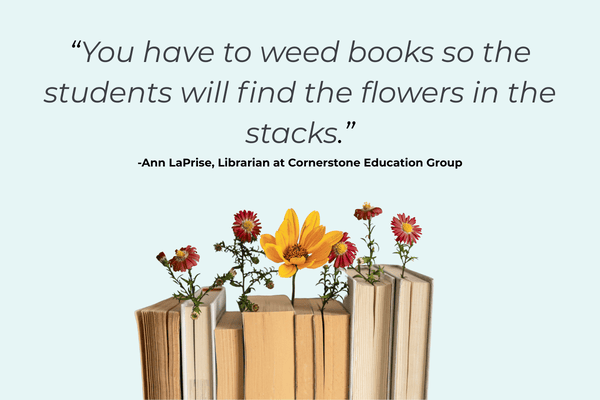
When people are asked about the most satisfying task in the library, they might say collection development, programming, or even shelving. But one of the most satisfying and underrated tasks might just be weeding.
I have spent years looking at circulation patterns and how they reflect the overall health of a collection, as well as how patrons perceive their library. Think back to your own school library. Was it inviting, with bright colors and engaging displays? Were the shelves open enough that you could actually find what you were looking for? Did the books feel current?

Or maybe it was colorful, but the shelves were packed tight with books that felt older than your parents.
Most of us recognize that experience. As librarians, we love books, but we also remember what it feels like to face crowded shelves and struggle to find something appealing. Overfull shelves are often a sign that a collection has not been weeded regularly. They can lead to lower circulation and a subtle sense that the collection is not for you.
So how do you improve it?
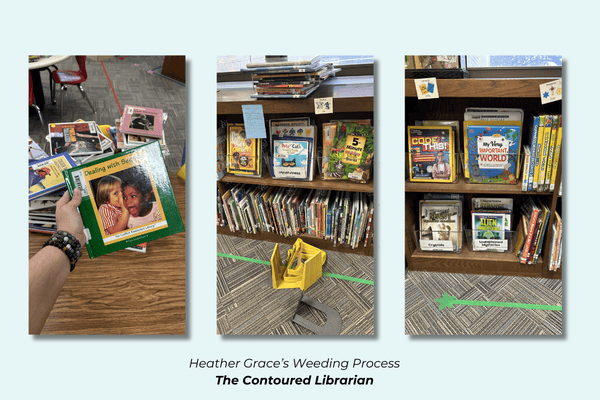
Start with intention. You do not have to weed everything at once. It can be tempting to stand in front of a shelf and pull anything that looks old, dusty, or worn. That approach can work, but a more organized process usually leads to better results.
A last circulation report is a strong place to begin. From there, focus on nonfiction, especially science and technology. A common guideline is to start with a five year window and evaluate from there. Not every title needs to go, but if something has not circulated in five years or more, it may be time to consider removing it. This also includes publication date, anything that can evolve and change in information needs to be addressed based on publication date. The most popular weeding guideline is the CREW method While the original guide is no longer available on Texas State Library Archive Website, you can find it here, or via a quick web search.
Collaboration is another key step. Talk with teachers and staff. What do they need to support the curriculum? Are there recurring units or projects where the collection could be stronger? Are there materials, like beginning readers, that could be shared with classrooms to free up space for new titles?
Weeding can sometimes lead to noticeable gaps, which can feel overwhelming, especially in a school setting. That is where a steady, ongoing schedule can make a difference. One approach is to alternate between weeding and replacement. Focus on one area at a time. It may take a full year to work through the collection, but the process becomes more manageable and less disruptive.
This is also where having support in place can make a real difference. JLG can help make your weeding and replacement plan easier to manage. By subscribing to nonfiction categories such as STEAM, Global Citizenship, Elementary Nonfiction, Sports Facts and Figures, Middle School Nonfiction, and YA Nonfiction, you can steadily refresh your collection one month at a time. This approach helps spread out costs and ensures that each delivery brings current, engaging nonfiction your students will actually use.
If you are focusing on Beginning Readers or fiction, those areas can be supported as well. Filling collection gaps is often part of a long term plan, but a subscription model can help you make immediate improvements without adding more work to your plate.
As shelves begin to open-up, new opportunities appear. Face out displays and simple in-shelf features can draw attention to high interest materials. Graphic novels, sports, and popular fiction are great places to start. When the focus shifts from quantity to quality, circulation often follows.

Of course, removing titles from your ILS can be one of the most time consuming parts of the process. This can be a good project for trained volunteers or older students, but it is also worth checking with your ILS vendor. Some systems offer batch withdrawal options that can save time while still supporting your standard procedures.
Weeding is not always quick or easy, but it is essential. A well maintained collection leads to stronger circulation, better engagement, and a library space that truly works for its community.
Liz Duffy, MLIS is the Director of Collection Curation for JLG. Previously she has worked as a Collection Development Librarian for Baker & Taylor, as well as an Account Manager for collectionHQ.