


Pollen: Darwin's 130 Year Prediction
By Darcy Pattison
Illustrators
Illustrated by Peter Willis
Edition
By Darcy Pattison
Hardcover edition
Publisher Mims House Imprint Mims House ISBN9781629441191
Awards and Honors Kirkus Best Books - 2019Pollen: Darwin's 130 Year Prediction
 6
6
Sold Out
SKU
9781629441191J
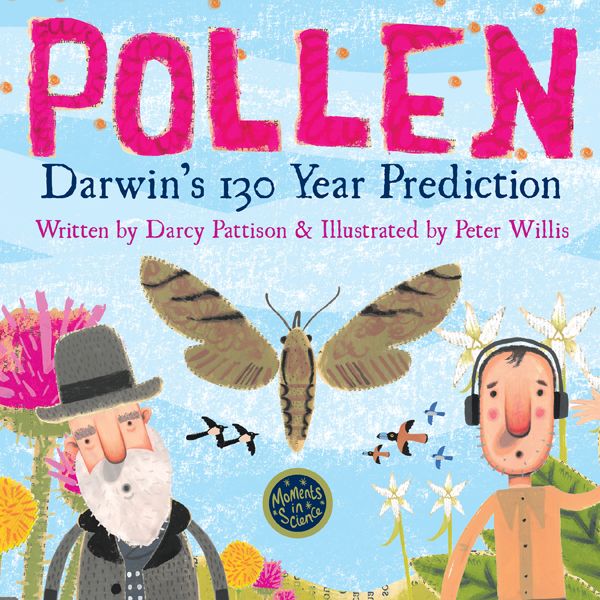
How long does it take for science to find an answer to a problem?
On January 25, 1862, naturalist Charles Darwin received a box of orchids. One flower, the Madagascar star orchid, fascinated him. It had an 11.5" nectary, the place where flowers make nectar, the sweet liquid that insects and birds eat. How, he wondered, did insects pollinate the orchid?
After experiments, he made a prediction. There must be a giant moth with a 11.5" proboscis, a strawlike tongue. Darwin died without ever seeing the moth, which was catalogued by entomologists in in 1903. But still no one had actually observed the moth pollinating the orchid.
In 1992, German entomologist, Lutz Thilo Wasserthal, Ph.D. traveled to Madagascar. By then, the moths were rare. He managed to capture two moths and released them in a cage with the orchid. He captured the first photo of the moth pollinating the flower, as Darwin had predicted 130 years before.
This exciting pollen science book includes backmatter information on the moth, the orchid, Charles Darwin, Lutz Wasserthal. Also included is Wasserthal’s original photo taken in 1992.
Further information on Morgan’s Sphinx moth, Madagascar star orchid, Charles Darwin, and Lutz Thilo Wasserthal. Sources. Glossary. Full-color illustrations and photographs.
On January 25, 1862, naturalist Charles Darwin received a box of orchids. One flower, the Madagascar star orchid, fascinated him. It had an 11.5" nectary, the place where flowers make nectar, the sweet liquid that insects and birds eat. How, he wondered, did insects pollinate the orchid?
After experiments, he made a prediction. There must be a giant moth with a 11.5" proboscis, a strawlike tongue. Darwin died without ever seeing the moth, which was catalogued by entomologists in in 1903. But still no one had actually observed the moth pollinating the orchid.
In 1992, German entomologist, Lutz Thilo Wasserthal, Ph.D. traveled to Madagascar. By then, the moths were rare. He managed to capture two moths and released them in a cage with the orchid. He captured the first photo of the moth pollinating the flower, as Darwin had predicted 130 years before.
This exciting pollen science book includes backmatter information on the moth, the orchid, Charles Darwin, Lutz Wasserthal. Also included is Wasserthal’s original photo taken in 1992.
Further information on Morgan’s Sphinx moth, Madagascar star orchid, Charles Darwin, and Lutz Thilo Wasserthal. Sources. Glossary. Full-color illustrations and photographs.
|
K Standard MARC Records Cover Art |
Nonfiction Early Elementary (Grades K-2)
Nonfiction Early Elementary
Nonfiction Early Elementary (Grades K-2)
For Grades K-2
Engaging nonfiction picture books and informational stories that introduce young readers to factual topics through true stories, simple narratives, and unique, visually appealing content. These titles feature clear concepts, inviting illustrations, and child-friendly explanations of subjects such as animals, dinosaurs, and the world around them. This collection supports early curriculum needs and encourages children to dive into learning while building curiosity and early exploration skills.
12 books per Year
$252.00 per Year
Interests
Nonfiction, Picture Books, Curriculum Support, Exploration & Discovery
Related Products